
Reviewed · AVEIRO TOURS
Aveiro: Stories, Canals, and Azulejos Guided Walking Tour
Aveiro’s canals make a fine first impression, but the stories behind its boats, tile-covered façades and salt trade give the city more staying power. This walk links those details into a clear picture of how Aveiro changed over the centuries, with guide Tony Walker bringing a local’s perspective to the route.
I like two things in particular: the tour looks closely at azulejos and architecture, rather than treating them as scenery, and it connects the canals to the lagoon’s traditional boats and salt production. One consideration: the walk is not suitable for people with mobility impairments or low fitness, and it goes ahead in rain or shine.
- Meet the city through its buildings: Visit the Carmelite Convent Church, the cathedral area, and the Church of São Gonçalinho.
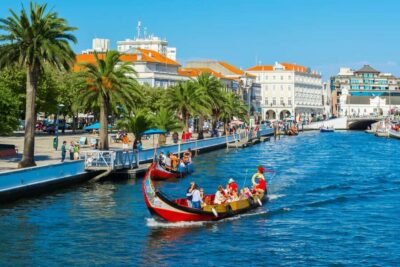
- Look beyond the canal postcard: Learn about the purpose of the canals and the lagoon boats, including moliceiros and mercanteis.
- Spot changing styles: See azulejos, Art Nouveau and Art Deco details, plus ironwork from the turn of the 20th century.
- Hear the local stories: The route covers Santa Joana, Aveiro’s salt trade, ceramics, and local food traditions.
- Keep the plan simple: It is a two-hour walk for $20 per person, with free cancellation up to 24 hours ahead.
Start at Praça da República
The tour begins near the statue in the center of Praça da República, beside two useful landmarks: the Town Hall and the Misericórdia church. Look for your guide wearing a yellow and blue badge. The meeting point is central, and the walk ends back there.
A guided start can make a difference in a city that is easy to admire quickly but harder to read. Aveiro’s buildings layer several periods and styles close together. A guide can help you distinguish what you are seeing, and explain why a tile panel, church façade or canal matters to the city’s story.
From the square, the route follows Rua de Coimbra, where the black-and-white Portuguese pavement becomes part of the introduction. It is a good reminder that the ground beneath your feet is also a local craft, not just a convenient way to get from one sight to another.
A small Baroque church, then tile façades
At Marques de Pombal square, the group enters the Carmelite Convent Church, described as a small but striking Baroque interior. Its modest scale is part of its appeal: you do not need a long museum visit to appreciate the contrast between the church’s intimate setting and its decorative style.
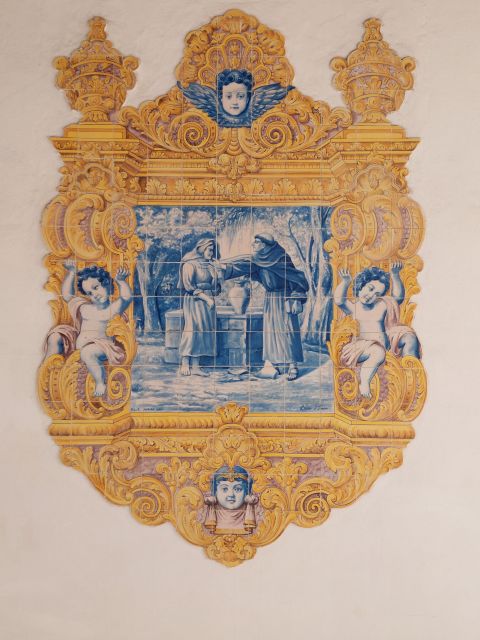
The walk then passes the tile panels of Casa de Santa Zita and Sapataria Leão. Here, the tour’s focus on azulejos becomes especially useful. Instead of simply noting that a building is covered in tiles, you can look at how the panels contribute to its design and what they say about Aveiro’s changing taste.
The route continues by the Dominican Convent of Jesus, where the story turns to Princess Santa Joana, the city’s patron saint. The tour also passes the cathedral. These stops help connect Aveiro’s religious buildings to the people and traditions that shaped local identity, rather than leaving them as a string of handsome façades.
More Aveiro trips around Aveiro:
- Aveiro: Traditional Moliceiro Boat Tour
★ 4.5 · 3,443 reviews - Aveiro and Costa Nova Half Day Tour from Porto with Boat Ride
★ 4.5 · 1,522 reviews - Aveiro: Scenic Guided Boat Tour
★ 4.4 · 1,047 reviews
Canals built for work, not just views
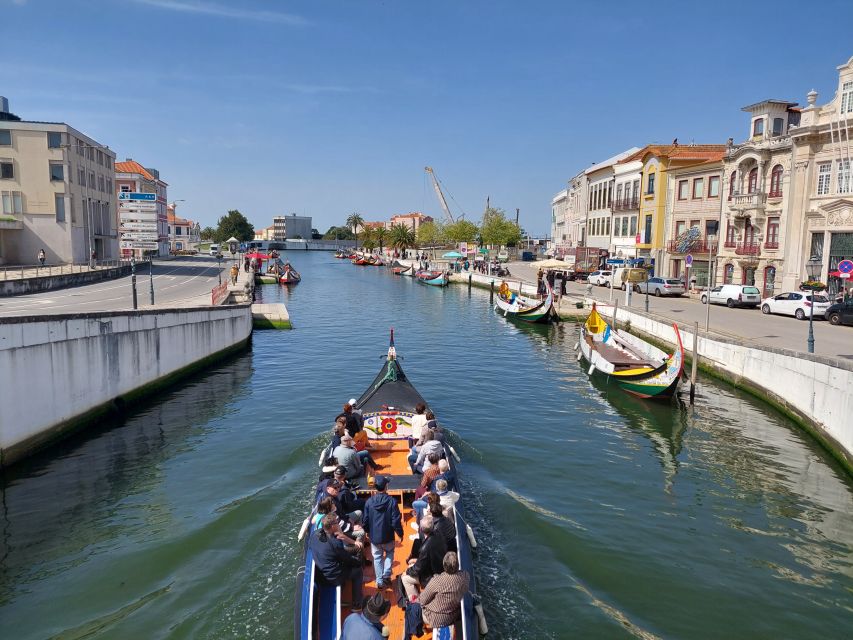
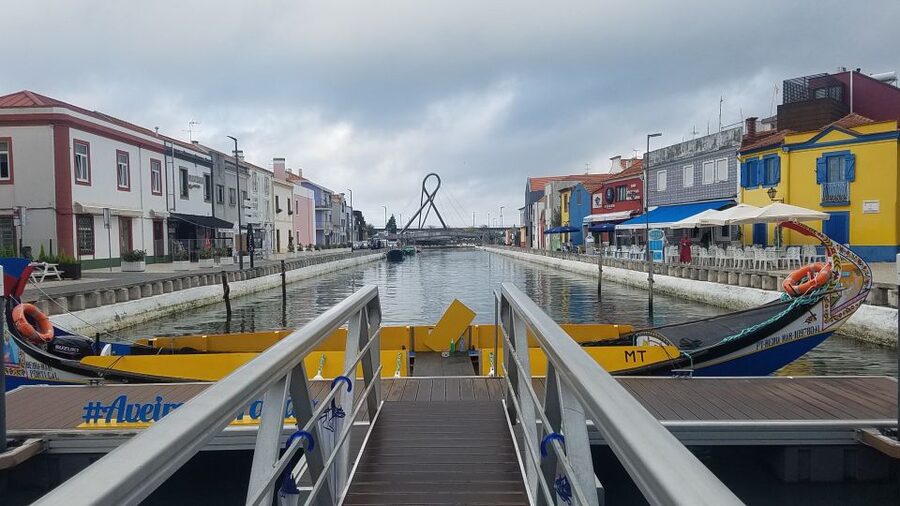
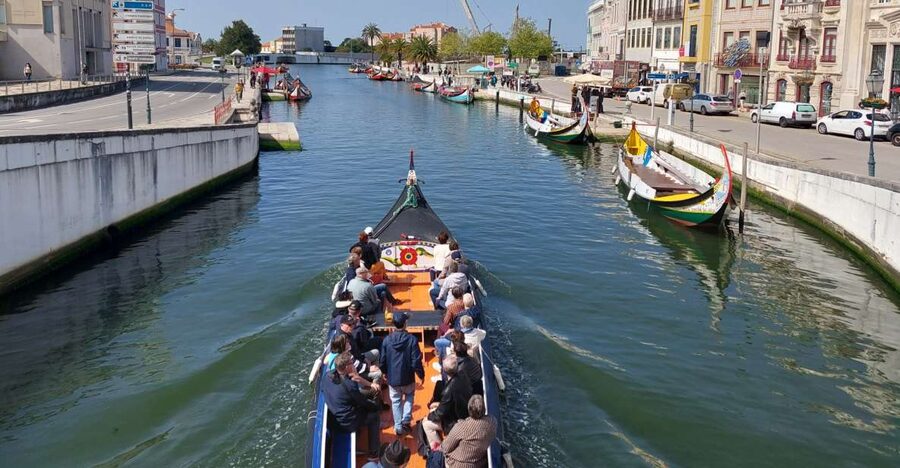
At Canal da Fonte Nova, an old ceramics-factory building remains beside the water. That surviving structure gives the canal a practical context. Aveiro’s waterways were not built only for scenic boat rides; they had a role in the city’s working life, and the guide explains how the canals developed and what they were used for.
The lagoon’s boats are another part of that story. You will hear about traditional craft such as moliceiros and mercanteis, and how to recognize different types. That knowledge is useful if you later see boats on the water and want to understand more than their bright paint and curved shapes.
The walk’s canal section offers a grounded way to think about Aveiro’s relationship with the Ria de Aveiro. The lagoon, salt and boats are not separate attractions here. They are part of the same local economy and history, and the tour connects them as you move along the water.
Beira Mar’s tiles and turn-of-the-century style
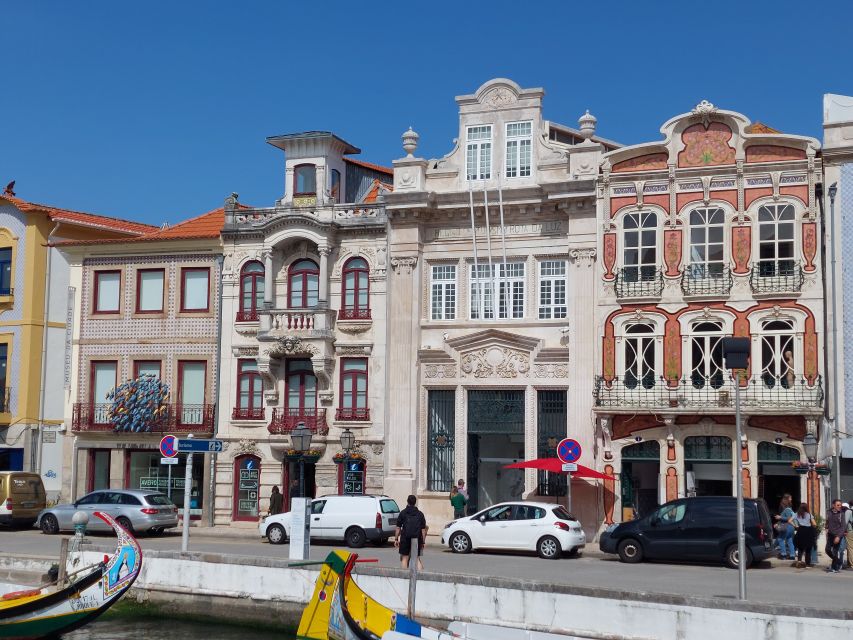
In the Beira Mar neighbourhood, tiles remain a constant presence, but the architectural details shift. The guide points out Art Nouveau and Art Deco touches, along with iron architecture associated with the transition from the 19th to the 20th century.
The two façades of the Museum of Art Nouveau are a particular stop on this part of the route. The focus is on what you can see from the street, rather than a promised museum visit. That distinction matters if you are planning around opening hours: the tour is primarily a walking experience, and its included sites are either viewed on the walk or have free entry.
This section suits anyone who likes to notice design details but does not want to study architectural history alone. You can ask questions as you go, and the route gives you a framework for spotting different styles elsewhere in town. The pace is intended to leave room for explanation, though the exact rhythm can vary with the group and the day.
Salt, decline and a city’s revival
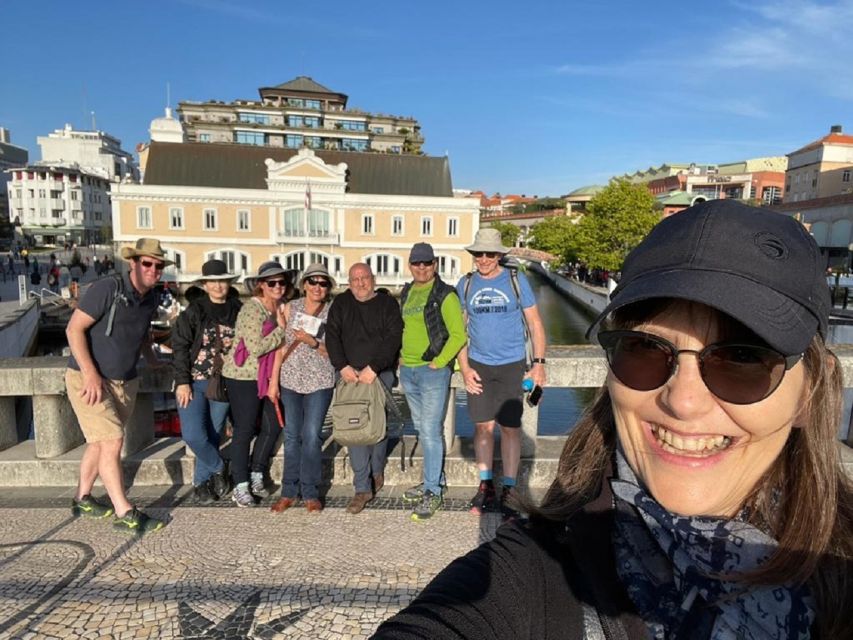
As the walk heads toward the saltpans, the subject shifts from architecture to Aveiro’s fortunes. The guide discusses the city’s power from the 11th to the 15th century, its difficult period in the 17th and 18th centuries, and its revival in the 19th century.
That broader timeline helps the canals and salt references fall into place. The tour does not just tell you that salt mattered; it links local work and trade to the city’s rise and later recovery. The route heads toward the saltpans, but the information provided does not promise a visit inside a salt operation, so treat this as a walking route with historical context rather than a salt-production demonstration.
The city’s past can be hard to piece together from individual landmarks. I like that the walk places religious history, ceramics, lagoon boats and salt within a longer account of Aveiro’s fortunes. It gives you a clearer sense of why the city looks and works as it does today.
More walking tours around Aveiro:
- Aveiro: Boat Cruise and City Walking Tour with Sweet Tasting
★ 4.7 · 318 reviews - Aveiro: Flexible Walking Tour in Historic Center
★ 4.2 · 6 reviews - Aveiro: Private Walking Tour in the City and Moliceiro boat
★ 5.0 · 3 reviews - Porto Walking Tour, Lello Bookshop, River Cruise and Cable Car
★ 5.0 · 3,354 reviews
End with sweets and a local January ritual
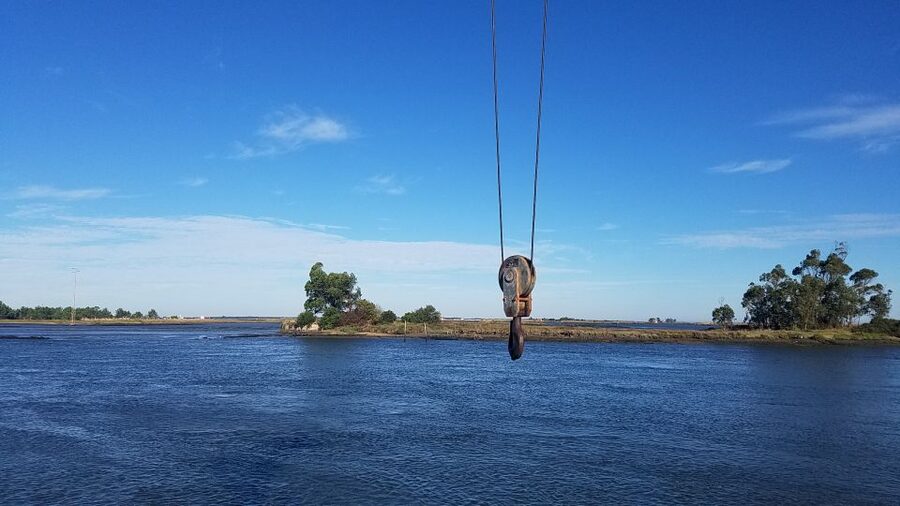
On the return route, the conversation turns to food, including eel stew and ovos moles, Aveiro’s traditional egg-yolk sweet. This is a brief introduction, not a tasting, since food and drinks are not included. Still, it gives you useful names to look for when choosing a café or bakery later.
The walk concludes at the Church of São Gonçalinho, where the guide explains the January festival associated with the church. During the celebration, a traditional hard, heavy sweet is thrown over the heads of the faithful in a lively ritual. It is an unusual detail, and a good example of how the tour moves from architecture to customs that remain part of local life.
The activity ends back at the original meeting point. If the church is the final storytelling stop, allow for the return walk when planning what to do next.
What Tony Walker brings to the walk
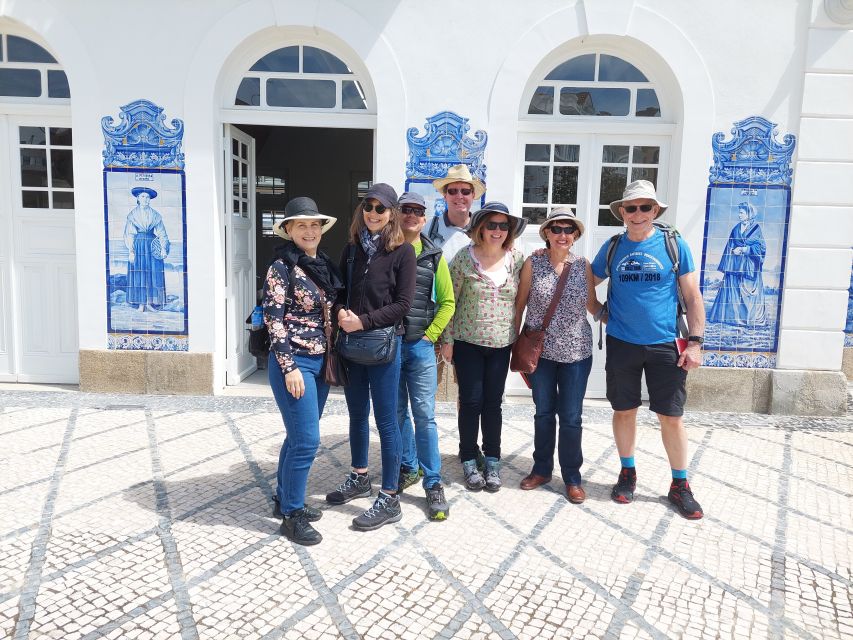
The guide’s role is central to this experience. Tony Walker, also addressed as Antonio or António, is described as a long-time Aveiro resident and a retired teacher. The tour’s strongest appeal is not simply that he names buildings, but that he gives context, answers questions and adds humor to the explanations.
That teaching background suits a route with plenty of subjects to connect: saints, architectural styles, salt, boats, ceramics and food. A guide who enjoys questions can help the walk feel less like a fixed lecture and more like an exchange. If you are curious about local history, this is a good format for asking what a detail means while you are standing in front of it.
The experience may also be more flexible than a strictly timed list of stops. One account describes the guide allowing extra time for stories and questions. Do not count on a private tour or an extended finish, but expect a guide who is willing to engage with the group.
Is two hours and $20 a good value?
At $20 per person, the value comes from the interpretation and the range of subjects, not from admission tickets or included food. The sites are either walk-through stops or free entry, and there is no meal or drink included. You are paying for a local guide to connect the city’s details across a two-hour route.
That can be worthwhile if you have limited time in Aveiro or if an unstructured stroll has left you unsure what you are looking at. The tour covers churches, tiles, canals, boat types, architecture, salt and local traditions in one compact walk. If you prefer to explore independently, many of the same streets and façades can be seen without a guide, but the stories and connections are the part you would miss.
Some museums may be closed on Mondays, and access to interiors can depend on what is open that day. The walk still offers plenty to see from the street, but if entering museums is important to you, check opening times before booking. The route itself is rain or shine, so bring weather-appropriate clothing, sunscreen when needed, and comfortable shoes.
The walk is not suitable for children under 10, pregnant people, wheelchair users, people with mobility impairments or people with a low level of fitness. Large bags, luggage, bikes, alcohol and drugs are not allowed, and minors cannot attend unaccompanied. Bring a passport or ID card, as well as shoes you can comfortably walk in.
Who should book this Aveiro walk?
Book it if you enjoy a guide who can make architecture and local customs easier to understand, or if you want an efficient first look at Aveiro before exploring on your own. It is especially well suited to visitors who like churches, tilework and local history, and who want to hear about the lagoon’s working traditions as well as see its canals.
Skip it if you need a step-free route, want a boat ride or food tasting included, or prefer to set your own pace without a group. The boat trip can be booked separately, so you can pair the walk with one if you want both perspectives.
For most curious visitors who can manage two hours on foot, this is a practical way to see past the postcard version of Aveiro. You get a route through the city’s key architectural and historical threads, plus a guide who can help turn details you might otherwise pass into useful clues.
FAQ
How long is the tour?
The guided walk lasts two hours.
What languages are available?
The tour is offered in Portuguese, French, English and Spanish.
Where does the tour start and finish?
Meet your guide near the statue in the center of Praça da República. The activity ends back at the meeting point.
Are food and drinks included?
No. Food and drinks are not included. The guide discusses local dishes and sweets, including eel stew and ovos moles.
Does the tour run in bad weather?
Yes. The tour takes place rain or shine, so bring clothing suited to the weather.
Is the tour suitable for children or people with mobility impairments?
It is not suitable for children under 10, wheelchair users or people with mobility impairments. Pregnant people and those with a low level of fitness are also listed as unsuitable for the tour.
Just in around Aveiro
- From Aveiro: Costa Nova, Barra, Vista Alegre – Half-Day Trip★ 5.0 · 8 reviews
- Porto: Aveiro with cruise, Costa Nova, Capelha do Senhor da Pedra★ 4.5 · 47 reviews
- Private Tour to Coimbra, Aveiro and Costa Nova★ 4.5 · 5 reviews
- Boat Trip in Aveiro★ 5.0 · 10 reviews
- AVEIRO and COSTA NOVA Private Full Day Tour from Porto★ 5.0 · 8 reviews
- Aveiro Half Day Private Tour Porto w/ Moliceiro River Cruise★ 4.0 · 12 reviews
- Aveiro & Costa Nova Private Tour – Canals & Striped Houses★ 5.0 · 15 reviews
- Aveiro Tour Small group, Moliceiro Cruise, Costa Nova, Vista Alegre & Lunch★ 5.0 · 13 reviews
Aveiro Tours, compared.

Aveiro and Costa Nova Half Day Tour from Porto with Boat Ride
Read our review →
Aveiro, Paiva Walkways and Arouca 516 Footbridge
Read our review →
Porto to Lisbon Up to 4 Stops: Aveiro, Nazare, Fatima & Obidos
Read our review →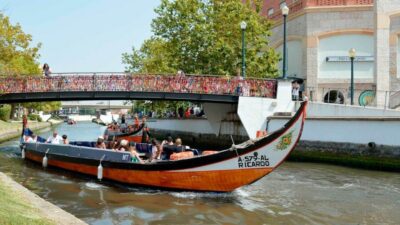
Aveiro, Cruise, Costa Nova & Capelha da Pedra Full Day
Read our review →Browse the lists this tour appears in