
Reviewed · GUIMARÃES TOURS
Best of Braga and Guimaraes Day Trip from Porto
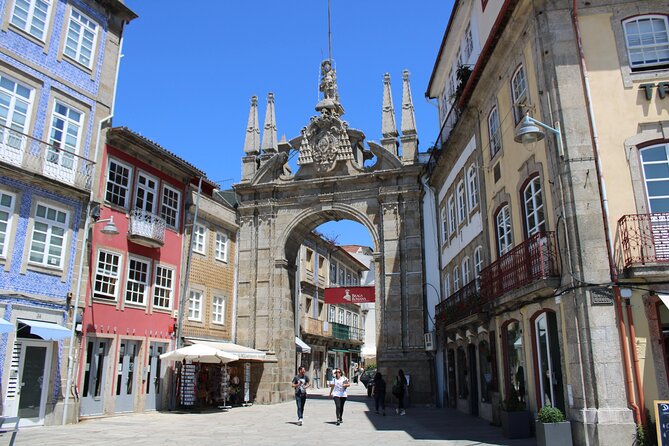
Bom Jesus gives this day trip its most striking scene: a monumental staircase climbing toward a church, with granite fountains and a rare 19th-century funicular that still runs on water power. Later, Guimarães brings you close to the origins of Portugal, from its castle to lanes within the old city walls.
I like the combination of distinctive sights and a guide who explains how they fit into Portuguese history. I also like having time to explore and eat at your own pace, rather than spending every minute in a group.
The trade-off is a full day, with an early start and several stops to manage. The guide may speak in English and a second language, which can mean repeated explanations and less free time than you might expect.
- Bom Jesus is more than a church: Its 300-meter funicular is a working piece of 19th-century engineering, and the staircase is the visual centerpiece.
- Braga Cathedral predates Portugal: Its construction began in the late 11th century, decades before the country was founded.
- Guimarães tells the nation’s origin story: The castle and old town connect you with the early history of Portugal.
- Admission is covered at three major sites: The cathedral, Bom Jesus Sanctuary, and Guimarães Castle are included.
- Expect a small-group vehicle, not a private tour: The minibus can carry up to 27 people.
- You get both guided visits and independent time: Plan to make your own choices for at least part of the day, including where to eat.
From Porto into Minho
The day begins at 7:50 a.m. near São Bento Train Station, at Calçada de Vandoma. Meet your guide there, then settle into an air-conditioned minibus for the drive north. The tour returns to the same meeting point after about nine hours, though traffic and visiting schedules can affect the finish time.
The road time is useful, not just a transfer. Your guide introduces Portuguese history, regional development, and cultural traditions as you head into Minho. That background helps make sense of the places ahead: Braga’s religious importance and Guimarães’s role in the formation of Portugal.
The group limit is 27. That is not an intimate private outing, but it is small enough for a guide to speak to the group and keep everyone moving between stops. The vehicle also gives you a break from walking, which matters on a day that includes historic streets, a castle, and a steeply set sanctuary.
Tours are usually conducted in one language, but a second language may be used. If your guide has to deliver the tour in English and Spanish, expect information to be repeated. The guide is still there to answer questions, but the pace and amount of free time can feel different from a single-language tour.
Bom Jesus and its water-powered funicular
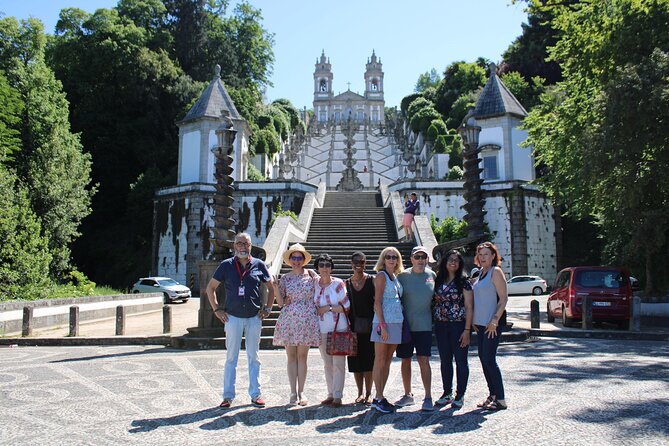
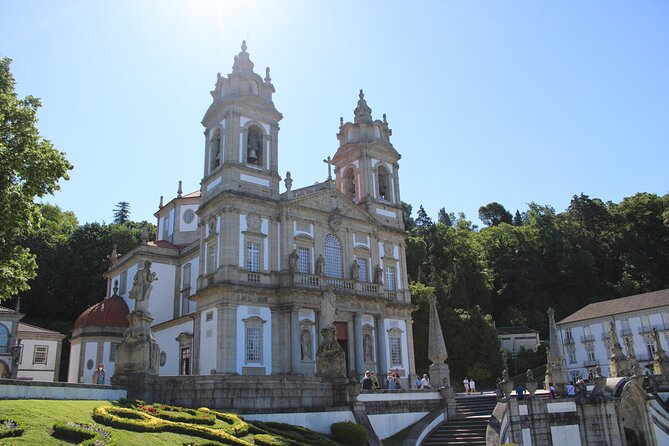
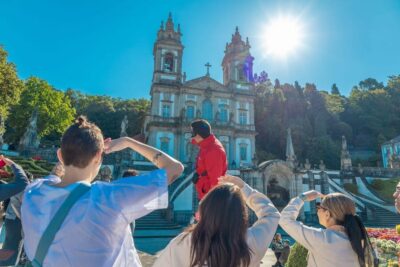
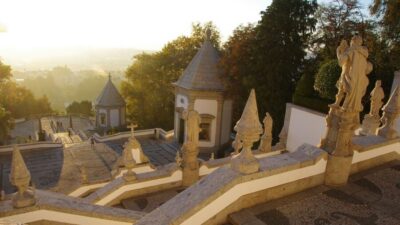
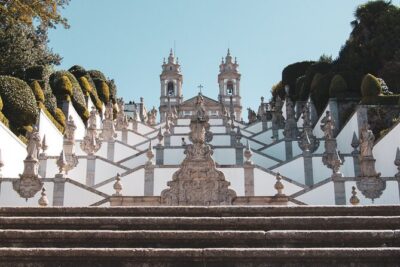
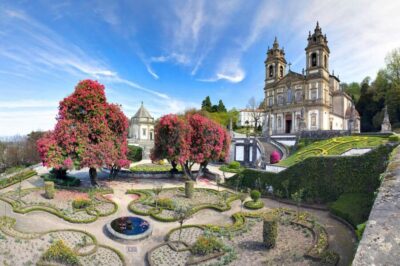
At Bom Jesus do Monte, the church is only part of the attraction. The sanctuary is known for its grand stairway, which rises through 17 landings decorated with fountains, statues, and Baroque details. The themes range from the Stations of the Cross and the five senses to the virtues and figures connected with the biblical story of Jesus’s condemnation.
Look up from the foot of the stairs before you start exploring. The white church appears to sit above the ornate granite fountains, and the rising sequence of landings gives the site its unusual sense of scale. You have about 30 minutes here, so focus on the main view and the details that interest you rather than trying to inspect every statue.
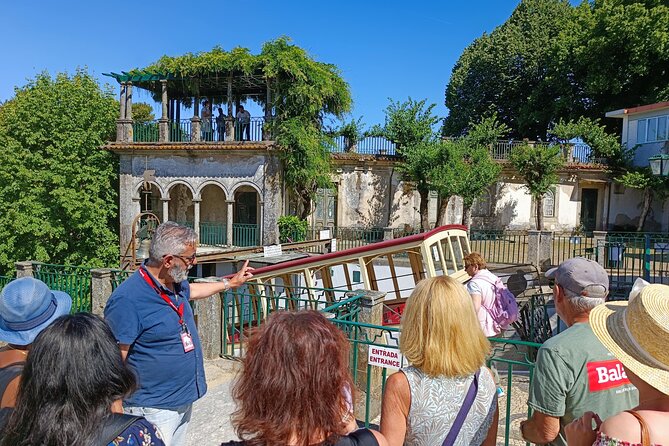
The funicular is another reason to pay attention. Installed in 1882, it was the first of its kind in Portugal and still uses water power to travel up a 300-meter ramp in about three minutes. It is a striking engineering detail at a site best known for faith and architecture.
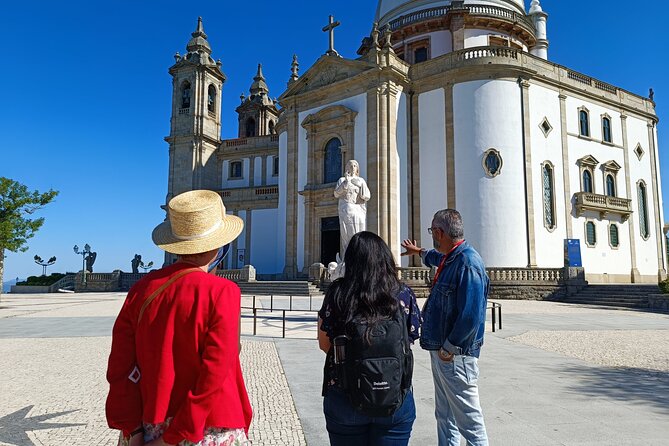
The church’s design, by Carlos Amarante, is neoclassical with an Italian influence. Its setting links the building to the surrounding hills rather than making it feel like a stand-alone monument. Entrance to the sanctuary is included, and the stop is listed as having no separate admission charge. The brief visit is enough to appreciate the setting, but not a leisurely climb and close look at every landing.
More Guimarães trips around Porto:
- From Porto: Braga and Guimarães Full-Day Trip
★ 4.6 · 3,951 reviews - Porto: Guimarães & Braga Tour with Entry Tickets and Lunch
★ 4.8 · 602 reviews - From Porto: Braga & Guimarães with Lunch Small Group Tour
★ 4.8 · 545 reviews
Braga Cathedral and a free-time pause
Braga Cathedral is the historic counterpoint to Bom Jesus. Construction began at the end of the 11th century, and the cathedral was consecrated in 1089, before Portugal existed as a country. Its age gives the visit particular weight: this is not simply another church stop, but a place tied to the region’s early political and religious power.
The cathedral competed for influence with Santiago de Compostela, and it remains one of Braga’s defining sights. Look for the Chapel of Kings, where D. Henrique and D. Teresa, the parents of Portugal’s first king, are buried. Admission is included, and the visit lasts about 30 minutes.
After the cathedral, you have roughly an hour of free time in Braga. Use it for lunch, a coffee, or a short wander through the city’s streets and shops. This is a practical pause in the schedule, especially before the second half of the day, and it lets you choose a meal to suit your appetite and budget. Lunch itself is not included.
You will need to keep an eye on the meeting time. Free time is welcome, but it is not the same as an unstructured afternoon, and the tour still has Guimarães ahead. If a particular café or shop catches your eye, enjoy it without letting the clock disappear.
Guimarães Castle and the early kingdom
The drive from Braga to Guimarães is short, but the historical shift is large. Guimarães is associated with Afonso Henriques, the first king of Portugal, who was born here according to local tradition. The city is often called the birthplace of Portugal, making the castle more than a picturesque ruin: it represents the early defensive center of the territory that became the country.
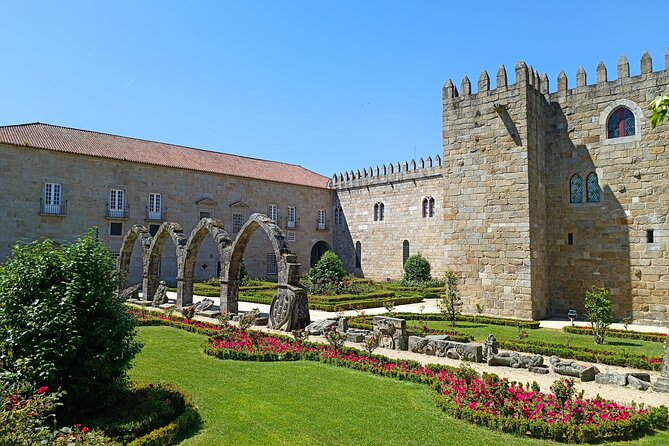
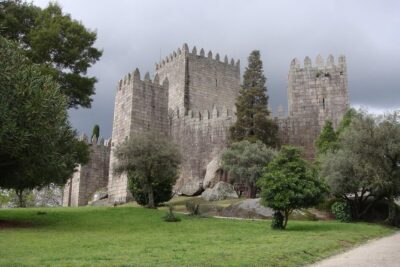
The castle’s origins go back to around 968, when Mumadona, Countess of Galicia, ordered a fortress built to protect local people from attacks by Vikings arriving from the north and Muslim forces from the south. Later, Count Henry ordered a larger, stronger structure. The square keep and four corner towers reflect the defensive role of the site.
Tradition also places the residence of Count Henry and the birthplace of Afonso Henriques near the castle’s northern wall, though that connection is not firmly documented. It is worth keeping that distinction in mind as you hear the stories: Guimarães blends evidence, legend, and national memory.
About 30 minutes are set aside for the castle, and admission is included. Access to the walls is now prohibited, so do not expect to walk along the ramparts. The castle may feel sparse if you are hoping for furnished rooms or a long indoor visit. Its value lies in the setting and the story of the early kingdom, rather than a large collection of objects.
The small church and Guimarães’s old streets
Near the castle, the small Church of São Miguel do Castelo offers a quieter stop. Built in the 13th century, it is Romanesque and plain in decoration. Local tradition says Count Henry built it in the 12th century and had his son, Afonso Henriques, baptized there. Warriors from the period associated with Portugal’s founding are buried beneath its floor.
You have about ten minutes here. That is enough to see the simple interior and take in the close connection between church, castle, and early royal story, but not enough for a long visit. Its modest scale is a welcome contrast with the grand staircase at Bom Jesus.
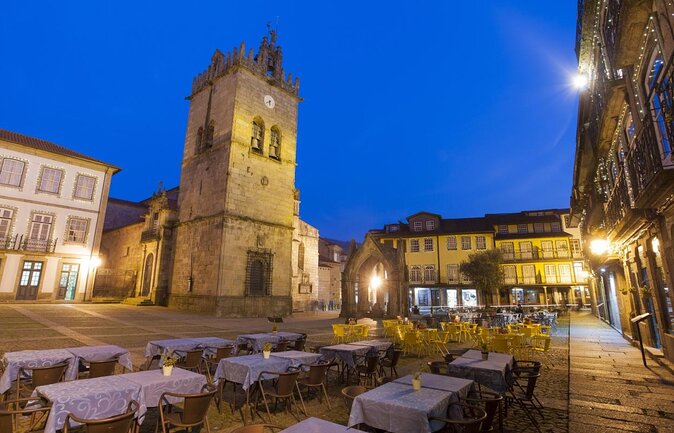
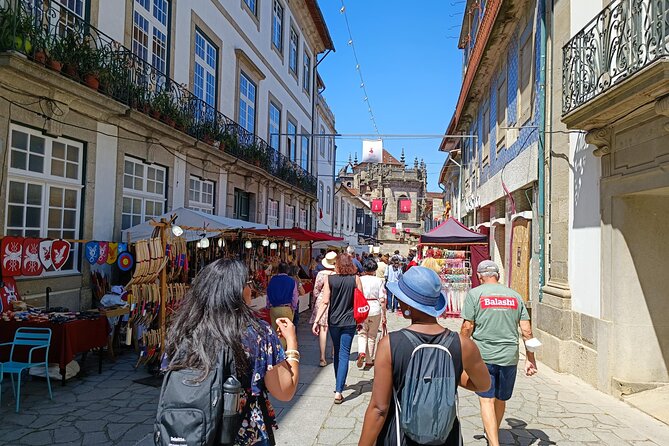
The historic center is the most atmospheric part of Guimarães. Its UNESCO World Heritage status reflects the originality and authenticity of its restoration. Granite balconies and porticos, iron verandas, arches between narrow streets, and old paving give the center a cohesive medieval character.
The guided walk lasts about 30 minutes, with time in the wider Guimarães stop for exploring and a meal. You may pass historic homes and palaces such as the Mota Prego house, Vila Flor Palace, and Toural Palace. The town is compact, so even a short walk can give you a good sense of its scale and architectural character.
This is also where the tour’s pace becomes a personal question. A guided walk helps you understand what you are seeing, while free time lets you browse shops or find lunch. If Guimarães is your main interest, the allotted time may leave you wanting more. I would treat this visit as an introduction, not a substitute for a longer stay.
More day trips around Porto:
- From Porto: Douro Valley w/ Boat Tour, Wine Tasting & Lunch
★ 4.7 · 19,061 reviews - Douro Valley Tour: Wine Tasting, Cruise and Lunch from Porto
★ 4.5 · 2,645 reviews - From Porto: 2 Wine Regions, Farm-to-Table Lunch & Boat
★ 4.9 · 2,318 reviews - From Porto: Tastings at 2 Wineries, Chef’s Lunch & Boat Tour
★ 4.9 · 1,784 reviews
Guides, pacing, and the value of the day
A strong guide can make a long day feel coherent. Guides praised by name include Castro, Christian, Jose, Pedro, and Philip. Their reported strengths include explaining history during the bus ride, answering unexpected questions, checking in with people, and balancing group visits with time to explore independently. Your guide will vary, so those names are examples rather than a guarantee.
The combination of guided context and free time is one of the tour’s best features. You get someone to connect Braga and Guimarães to the wider story of Portugal, but you are not led by the hand at every moment. Several people found the pacing comfortable, with enough time at the stops and a useful break for food.
Weather can change the feel of the day. The tour runs in rain, and the outdoor stops at Bom Jesus and Guimarães can be damp and cold. Bring clothing suited to the forecast and shoes you are comfortable walking in. The minibus is air-conditioned, which helps on the road, but it does not remove the need to be ready for the weather outdoors.
At $71.35 per person, the price is reasonable for a nine-hour outing that includes transport, a professional guide, and admission to Braga Cathedral, Bom Jesus Sanctuary, and Guimarães Castle. You also get a walking tour in Guimarães. Lunch and personal expenses are extra, and hotel pickup and drop-off are not provided. You will need to reach the meeting point yourself.
The tour also includes access to a separate Porto walking tour from the day after your experience. It runs daily in English and Spanish at 9:30 a.m. and 4:30 p.m., departing from Living Tours at Rua Mouzinho da Silveira 352. That is a useful extra if you want a guided introduction to Porto, though it is separate from the Braga and Guimarães day.
Should you book this Braga and Guimarães trip?
Book it if you want a guided introduction to two important northern Portuguese cities without arranging transport, tickets, and historical context yourself. The contrast between Bom Jesus’s elaborate stairway, Braga’s early cathedral, and Guimarães’s medieval center makes for a varied day, and the included admissions improve the value.
Think twice if you prefer slow visits, dislike bilingual guiding, or want a full day in either city. Nine hours is a lot of time on a fixed schedule, and Guimarães Castle is a limited-access site with no entry to its walls. For a first visit from Porto, though, this is a practical way to see the main sights, learn how they connect, and decide where you would like to return.
FAQ
Where does the tour start and end?
It starts at Calçada de Vandoma, near São Bento Train Station in Porto, and ends back at the same meeting point.
What time does the tour start?
The stated start time is 7:50 a.m.
How long is the day trip?
The tour lasts approximately nine hours. Traffic and visit schedules can affect the total time.
Is lunch included?
No. Lunch and personal expenses are not included. You have free time to explore Braga and find something to eat.
Which admission fees are included?
Admission to Braga Cathedral and Guimarães Castle is included, along with entrance to Bom Jesus Sanctuary.
Can the tour be conducted in more than one language?
Yes. Tours are usually in one language, but a second language may be used.
How many people can join the tour?
The maximum group size is 27 people.
Can you walk on the walls of Guimarães Castle?
No. Access to the castle walls is currently prohibited.
Is cancellation free?
You can cancel for a full refund up to 24 hours before the experience starts. Changes or cancellations made less than 24 hours before the start are not accepted for a refund.
More one-day tours around Porto
- Day Trip from Porto to Santiago de Compostela and Valença
★ 5.0 · 883 reviews - From Porto: Arouca 516 and Paiva Walkways Guided Day Trip
★ 4.9 · 456 reviews - Day Trip Braga and Guimarães from Porto
★ 4.5 · 237 reviews - Porto: Santiago de Compostela and Valença do Minho Day Trip
★ 4.5 · 181 reviews
Just in around Porto
- Porto : Private Tour of the Historic City in a Classic Ford T★ 5.0 · 13 reviews
- Workshop Nate Pastel and Cocktails in Porto★ 5.0 · 64 reviews
- Pastel de Nata Workshop in Porto★ 5.0 · 127 reviews
- Private Tour to Lamego and Viseu, the Dão wine region★ 5.0 · 3 reviews
- Porto City Tour with Wine Tasting★ 3.5 · 30 reviews
- Douro Valley Private Day Trip including Boat Ride & Wine Tasting★ 5.0 · 96 reviews
- Paiva Walkways & Arouca Suspension Bridge – All Inclusive!★ 5.0 · 62 reviews
- Adventure Paiva Passages: Suspension Bridge and Picnic | Porto★ 4.5 · 4 reviews
Guimarães Tours, compared.
Guimarães & Braga Tour with Entry Tickets and Lunch
Read our review →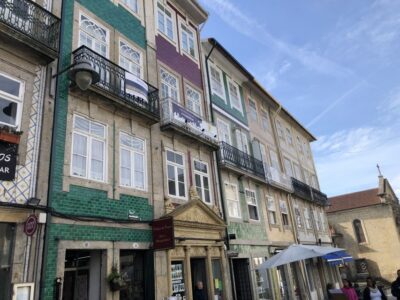
Braga & Guimarães Small Group Tour: Lunch & All Tickets Included
Read our review →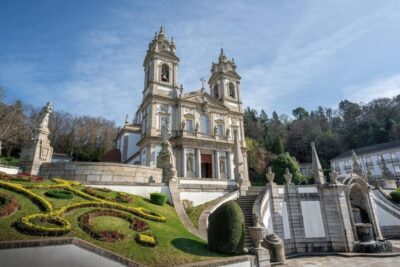
Guimaraes & Braga Small Group Tour with Lunch and Tickets
Read our review →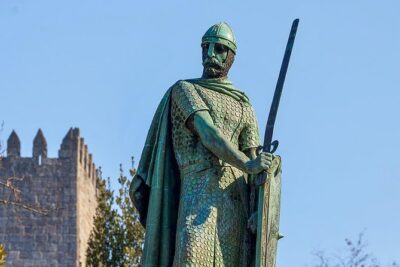
Browse the lists this tour appears in